
Used-oil and waste spend, reconciled per pickup.
Pickup events, manifests, tank deltas (where AFMS or telemetry is connected), vendor invoices, and used-oil credits in one workflow. See net cost by site and vendor — and recover missing credits with evidence.
Pickup-to-invoice reconciliation
Missing used-oil credit detection
Manifest matching
Net cost per site and vendor
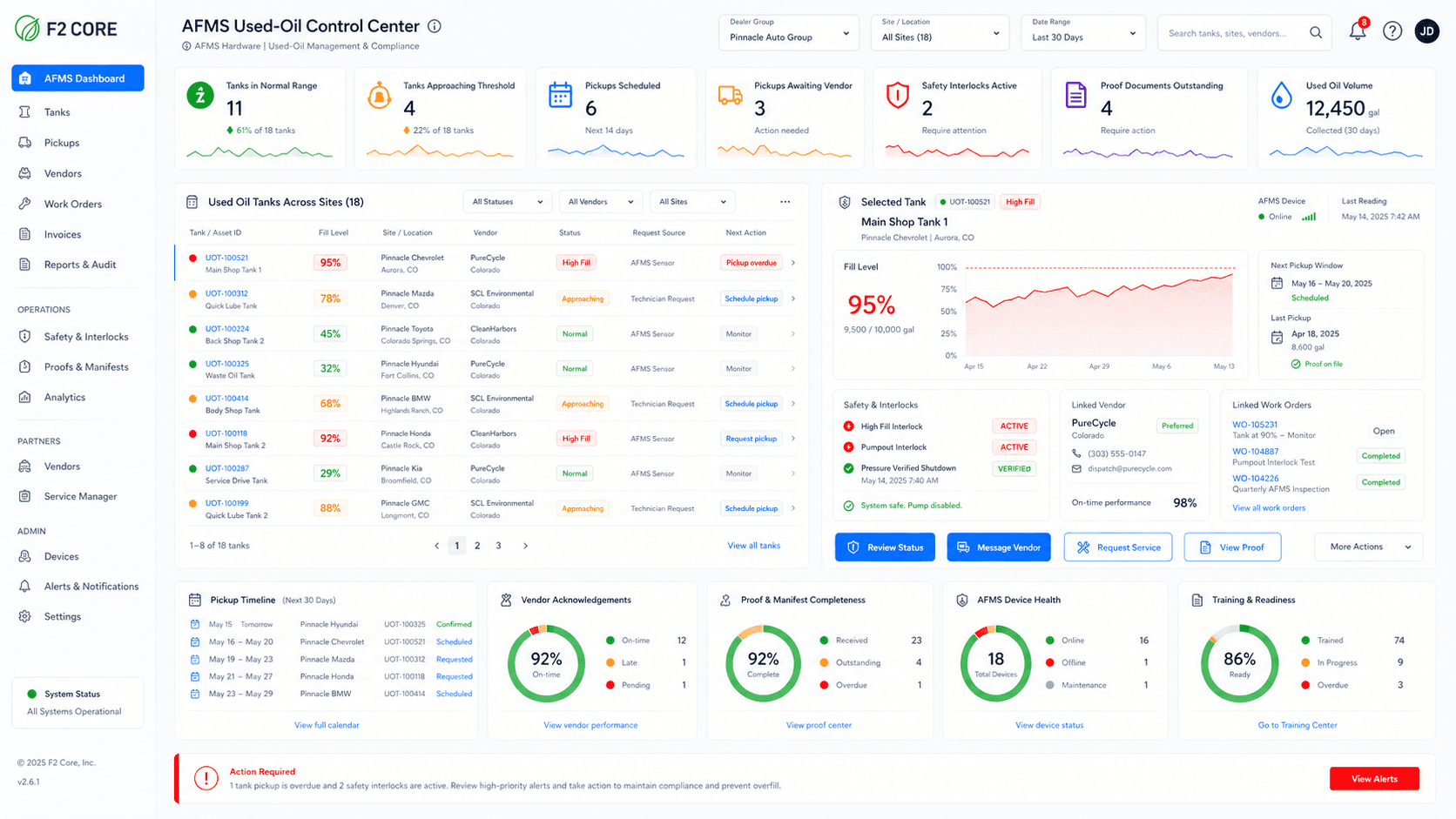
The full waste spend picture
What used to live in service, environmental, AP, and vendor email threads now sits on one record per pickup.
Pickup record
Date, site, tank or container, vendor, route, requested service, and ticket number.
Manifest
Generator copy, hauler signature, transporter ID, disposal facility, and waste codes.
Tank delta
Before/after level (where AFMS is connected), estimated gallons, and confirmed gallons.
Vendor invoice
Gross charge, line-level detail, surcharges, fuel fees, environmental fees.
Credit memo
Used-oil credit, recycling rebate, or commodity adjustment — applied to the right pickup.
Net cost
Per pickup, per site, per vendor, per period — the number leadership actually wants.
Recover missing used-oil credits with evidence.
Missing credits are one of the highest-confidence leakage categories in dealership facility spend. SpendGuard surfaces pickups that should have produced a credit and routes a professional, source-cited request.
No autonomous vendor disputes. Authorized users review the evidence, approve the request, and validate the credit when it arrives.
Pickup recorded with manifest and tank context
Vendor invoice arrives — credit missing or short
SpendGuard surfaces opportunity with cited evidence
Authorized user approves the credit request
Credit memo received and validated against the original pickup
Environmental compliance disclaimer
F2 Core supports environmental workflows, organization, documentation, and evidence readiness. It is not a substitute for legal advice or a qualified environmental compliance review.
Used Oil & Waste Spend questions
A pickup event in F2 (or AFMS) is tied to the manifest, the tank before/after level where AFMS or telemetry is connected, the estimated gallons, the vendor invoice, and any credit memo. The result is a per-pickup view of gross charge, credit, and net cost.
SpendGuard still reconciles the pickup record, manifest, invoice, and credit. Tank-level deltas are richer when AFMS data is available, but they are not required for invoice and credit matching.
Missing-credit findings move through the opportunity workflow: identified → accepted → credit requested → credit received → realized. The vendor dispute is professional, source-cited, and approval-controlled.
SpendGuard scope and savings disclaimer
F2 SpendGuard surfaces invoice exceptions, contract compliance signals, and savings opportunities with source-cited evidence. It does not approve invoices, post payments, send vendor disputes, or replace AP / accounting systems — every financial action requires authorized human review. SpendGuard does not promise a fixed savings percentage; savings are tracked across five distinct states (potential, accepted, validated, realized, sustained) and reported separately.
See net cost per pickup, per site, per vendor.
A SpendGuard demo walks through a sample pickup-to-invoice reconciliation with a missing credit recovery.